

Evaluation Checklist for Aerospace Manufacturing Execution System (MES)
Choosing the wrong MES for aerospace AIT locks you into years of workarounds. The wrong platform fails at scale, struggles with compliance evidence, or can’t connect to your test benches without custom development.
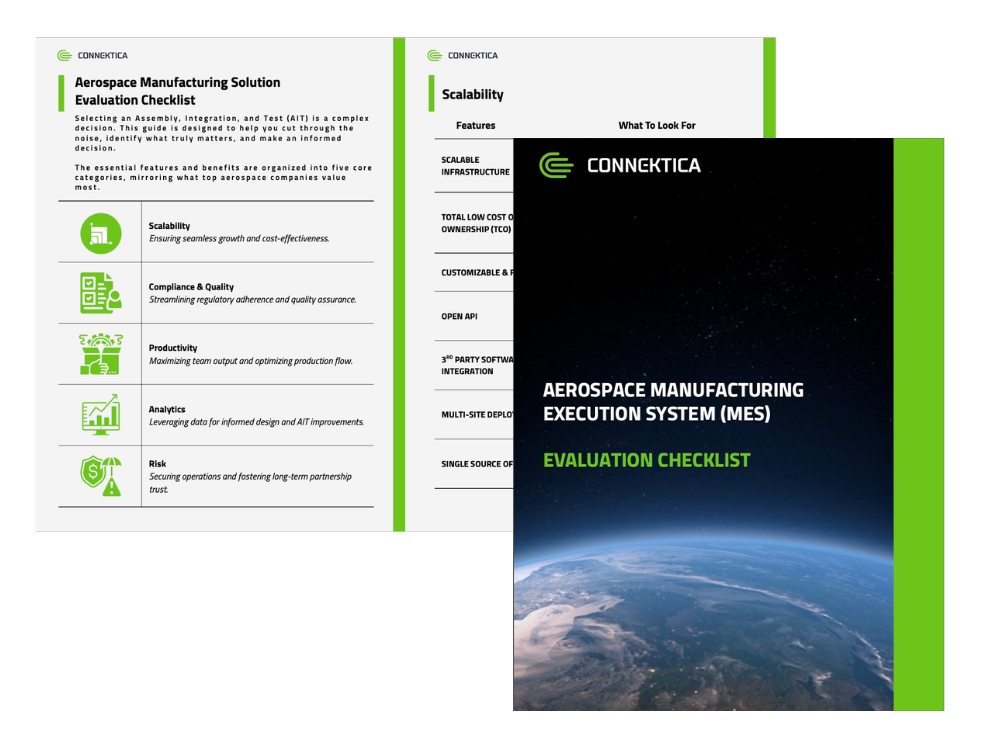
This checklist gives you the five criteria that matter most for aerospace manufacturers and the specific questions to ask every vendor you evaluate.
1. Will it cost effectively scale with you, or hold you back?
The MES you pick today has to work at 20 units/year and still work at 500. Most platforms don’t fail in year one, but when you try to add a second production site, connect a new test bench, or bring a supplier into your workflow without exposing your IP.
Check the criteria below with each vendor to validate that their platform is future-proof:
If the platform is cloud only, this will be an issue for classified programs, but if it’s only on-premise, it may have a hard time handling multiple site deployments. Look for a platform that supports cloud-based architecture (public, private, on-premise) with the ability to easily switch between them.
A low sticker price on the aerospace MES alone can hide the real cost: a separate test-automation tool, a separate integration project, and the engineering hours to connect them. Look for a platform that combines instructions, testing, and data management natively, reducing integration and maintenance costs rather than shifting them onto you.
If configuration always routes through a systems-integrator ticket, each new sequence costs you time and money. Look for a platform where screens and sequences are easy to customize directly, by your own engineers.
A closed format limits how easily you can connect and control the diverse systems (e.g. ERP, PLM), instruments and test equipment your production flow and AIT sequences actually need. Look for open APIs and SDKs that rely on open standards and popular coding languages.
Managing AIT processes across multiple sites is a must-have the moment production scales beyond one. Look for the ability to deploy and monitor AIT processes across multiple production sites instantaneously.
AIT engineers and IT teams shouldn’t be spending their time developing and maintaining integrations between apps just to get one answer. Look for a single database covering AIT sequences, AIT configuration, testing, and environmental data.
2. Will it help you comply with EN9100/AS9100 requirements and guarantee aerospace-grade traceability?
Aerospace companies need to assemble a lot of evidence and data to demonstrate compliance to their customers requirements and regulatory bodies. If the MES cannot do that by itself, then this task can take hours, if not days.
Validate the criteria below with each vendor to assess if their platform ca support aerospace-grade compliance and traceability:
Non-conformity management that’s separated from AIT execution translates directly into delays and missing context when you need it the most. Look for automatic, central tracking of non-conformities linked to key information such as sequence, part or serial number, and lot number.
Controlling operator competency and instrument calibration before operations is a key requirement for EN9100 and AS9100. Look for automated checks at the start of operations, confirming required qualifications & calibrations are met.
Pass/fail recording is essential for compliance. If done manually, it is error-prone and only captures the result, and not the underlying data. Look for automated control checks that prevent manual recording errors, and record the full context behind each measurements.
Space primes and aerospace customers require extensive evidence and End Item Data Packages to meet EN9100 and AS9100 requirements. Look for customizable EIDPs, automatically generated from AIT data.
Without robust version control, it’s near-impossible to trace which sequence or driver version built a given serial number. Look for the ability to track which sequence and driver version was used to build each serial number, with version numbers recorded automatically in EN9100/AS9100 reports.
Without a clear lineage of parts, both compliance and troubleshooting turn into work that’s time-consuming and often still incomplete. Look for automatic tracking of full product lineage and history, with that data reported directly into EN9100/AS9100 reports.
Access control is a requirement under EN9100 and AS9100 and is hard to enforce well across disparate systems. Look for a granular, role-based permission engine restricting who can run or configure sequences and view sensitive AIT data.
3. Will it make your team faster, or give them another system to update with little value to them?
Systems designed for the 20th century or enterprise customers are not a good fit for small and mid-size manufacturers. They are overly complex and not liked by the younger employees that this companies tend to hire.
Check the criteria below with each vendor to confirm the platform will save them time:
Easy onboarding, for new employees and suppliers, is what lets you scale without production disruptions. Look for a modern, intuitive interface similar to the consumer apps operators already use every day.
Data scattered across tools, databases, and files is difficult and time-consuming to search when someone needs an answer for a customer or non-conformity. Look for comprehensive search across all production and test data, with instant access to information.
Tablets for AIT execution unlock workflows a desktop-only tool can’t, particularly useful for larger space products. Look for a responsive interface that adapts seamlessly between desktops and tablets, with full functionality on either.
Manual processes are error-prone, inconsistent, and slow down complex assembly and test procedures. Look for digital workflows that guide operators step by step, reducing errors and standardizing operations.
Engineer-dependent test procedures cap your throughput and capacity to scale production. Look for automated control of any instrument, equipment, or API, with automated collection of testing and environmental data.
Without a visual builder, engineers lose hours to complex scripting and clunky interfaces. Look for a visual, no-code builder that lets engineers configure and maintain complex AIT processes without writing code.
Without real-time visibility, identifying a bottleneck is reactive, which means delays and missed customer commitments. Look for real-time visibility into the status of your production lines, down to each item for every final product.
4. Will the platform capture the data you need to improve your product's design and AIT processes?
AIT, and testing in particular, generate large quantities of data, essential to improve the product’s design and manufacturing process. If your MES is not built to handle aerospace data, you will need another platform just to handle that.
Check these criteria to verify that the platform can manage your data:
Without standardized, centralized data, in-depth analysis is tedious and can’t be adjusted quickly as your needs evolve. Look for a single data store holding all your AIT data in a standardized format, ready to share with advanced analytics platforms.
Operators can’t capture all the relevant contextual data by hand, so the manufacturing and design engineers need to dig for it later. Look for the ability to record sensor information, environmental conditions, and operator activity in real time.
Aerospace testing is complex and time-consuming, and you can’t scale a process that depends on engineers manually copy-pasting data into Excel instead of designing and improving the product. Look for out-of-the-box visualizations and graphs that evaluate complex test results and flag quality drift as it happens.
Business intelligence that’s disconnected from the AIT solution needs its own integration and its own maintenance. Look for built-in BI capabilities.
Every manufacturing process is unique, and a rigid dashboard limits how precisely you can actually monitor production. Look for customizable dashboards with a wide variety of parameters and charts.
5. Will it secure your aerospace data, IP, and operations long term?
Aerospace product designs and manufacturing processes are sensitive information, subject to export control restrictions for some.
Validate the criteria below with each vendor to assess if their platform will protect your data and IP:
Aerospace primes and government agencies demand stringent data protection. Look for ISO 27001-certified hosting, end-to-end encryption, role-based access controls, and evidence of regular third-party penetration testing.
Many suppliers and primes require on-premise or regional data residency as a condition of doing business. Look for the ability to deploy in your preferred region, such as Europe, the US, or Canada, or fully on-premise, with clear data-location guarantees and compliance attestations in writing.
In the case of Cloud deployments, assess the measures taken to ensure business continuity (e.g., SLA, disaster recovery, backups).
Choosing a vendor without proven aerospace success is a real risk, given how strict the industry’s requirements actually are. Look for aerospace-ready capabilities out of the box, and references specifically from aerospace and defense customers.
Software pricing can become unpredictable as companies grow. Look for a transparent, consistent pricing model that lets you forecast the real cost as you scale.
Download your Aerospace MES checklist
Use the Excel list to customize each criteria and weight associated with it, so that you can easily compare each MES solutions you’re considering