Toulouse, 23 February 2026
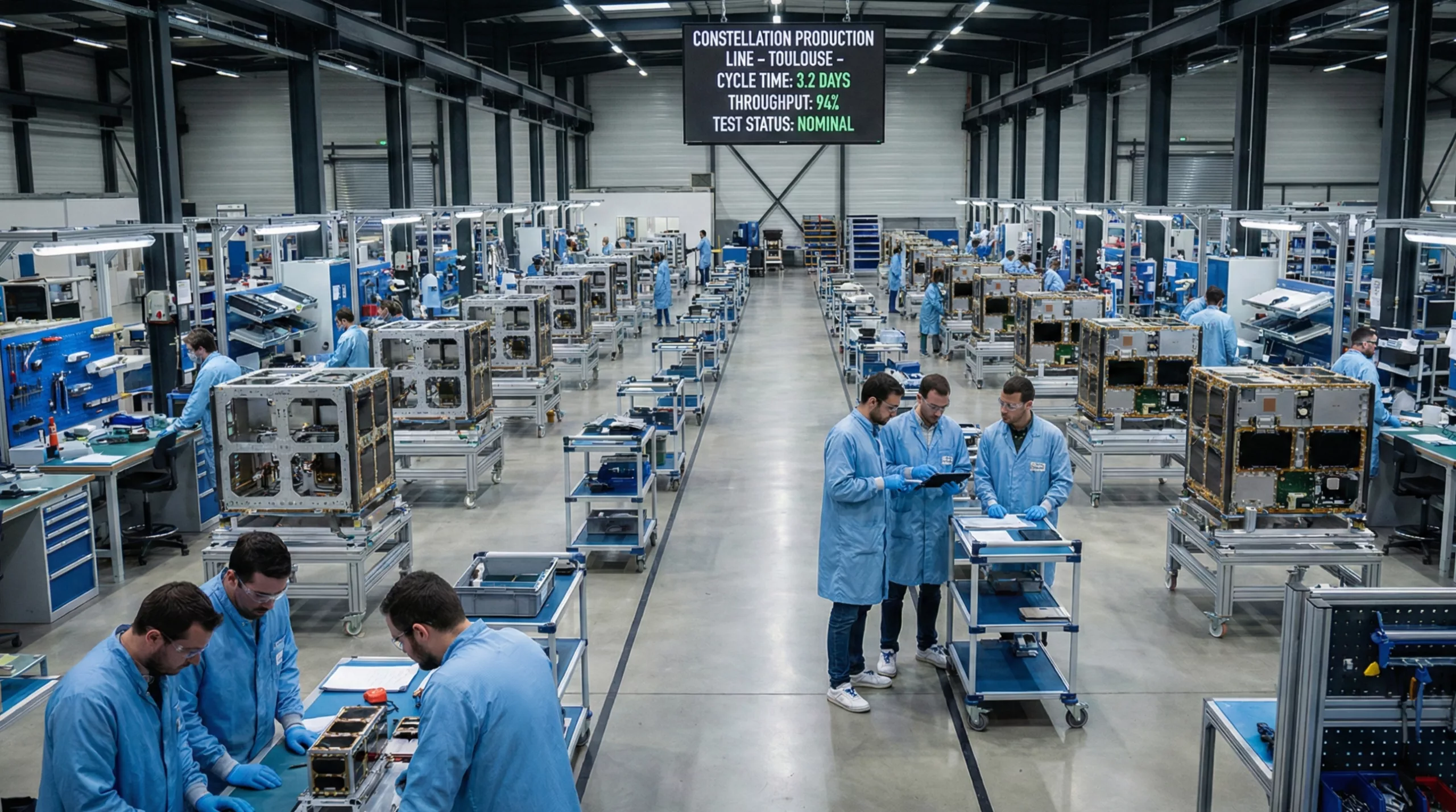
The Toulouse space ecosystem is undergoing a structural shift that goes beyond market cycles. The decline of geostationary programs and the rise of low-earth orbit constellations have changed the production logic entirely. Volume, speed, and repeatability now define competitive positioning. Assembly lines for constellation-scale production exist at Airbus Defence & Space and Hemeria, but the broader ecosystem has not yet matched that pace.
Defense acceleration is compounding this pressure. Following President Macron’s January 2026 address to the armed forces, French spatial actors face explicit expectations around rapid deployment capabilities. Germany and Sweden chose Planet and Iceye because those companies had satellite stock ready to deploy. Whether Toulouse can match that reactivity today remains an open question. That competitive gap is a production and process failure, not a technology failure.
The talent structure reinforces the problem. A 2023 Aerospace Valley diagnostic found that 70% of the sector’s workforce consists of engineers, while industrialization demands technicians and skilled operators. Engineering demand is projected to double or triple by 2032. The workforce pipeline is misaligned with production requirements.
At the same time, the traditional V-cycle development model creates structural delays. Contractualization for defense missions such as Yoda required 12 months. Production and testing cycles remain long and poorly digitized. The ecosystem requires iterative industrial models that compress timelines without sacrificing traceability or compliance. This is the industrial condition Toulouse must solve to remain Europe’s leading space capital.
In this context, Air & Cosmos highlights Connektica’s role in optimizing high-complexity production processes:
“Pour accélérer l’adaptation, des entreprises spécialisées dans l’optimisation des processus de production à haute complexité se proposent. C’est ce que propose la start-up toulousaine Connektica aux acteurs du spatial et de la défense. La genèse de la start-up provient du travail de son fondateur, Jérémy Perrin, chez l’intégrateur canadien MDA Space, qui a réussi à diviser par vingt le temps de production et de test d’une antenne de satellite OneWeb. Objectif : standardiser, digitaliser et automatiser les processus de production et de tests des produits, casser les codes. « C’est la fin du cycle en V. Place aux itérations entre les aspects de design et industriels », nous précise Jérémy Perrin.”
—
Air & Cosmos, February 21, 2026, by Daniel Chrétien
A factor-of-twenty reduction in production and test time on a OneWeb antenna is a concrete industrial result, not a methodology claim. It establishes a performance baseline that operations leaders can evaluate against their own cycle times.
Connektica operates at the point where design intent meets production execution. Standardizing, digitalizing, and automating those handoffs removes the manual coordination that inflates timelines in high-complexity programs. For defense programs operating under classification constraints and compressed calendars, that capability is operationally relevant.
The shift from V-cycle to iterative industrial logic is not a startup thesis. It is already the operating model of the Pentagon’s Space Development Agency in its PWSA constellation procurement. Toulouse must reach the same production cadence to compete for European and allied defense contracts.
The Air & Cosmos article also identifies Nicolas Capet, CEO of Anywaves, and Cyril Brotons, Director of Industrial Strategy and Products at U-Space, as contributors to this industrialization wave. Anywaves built its antenna production capability specifically for the constellation market. U-Space developed and applied standardized approaches to delay classification constraints in defense satellite missions. Both actors illustrate that constellation-scale production in Toulouse requires deliberate industrial architecture choices, not incremental adaptation of heritage processes.
Read the full article by Daniel Chretien on Air & Cosmos
The industrial transformation underway in Toulouse reflects a broader structural evolution affecting every European aerospace manufacturing hub competing for a role in the next generation of space and defense infrastructure.